
DIY Pool Maintenance
Understanding How Your Pool Filter System Works
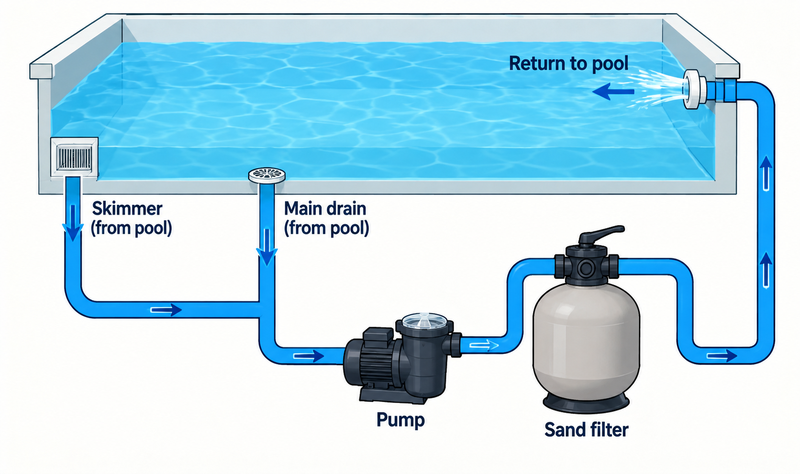
Your swimming pool filter system is quite simple. It works in a continuous cycle:
Pool → Pump → Sand Filter → Back to Pool
The water is taken from the pool, passed through a filter to remove dirt and debris, and then returned to the pool. This process repeats while the pump is running, helping to keep your pool water clean and clear.
1. The Return Jets
The return jets are small outlets usually located just below the water's surface.
They push filtered water back into the pool, creating movement across the surface. This movement helps carry floating debris, such as leaves, insects and dust, towards the skimmers.
2. The Skimmers
Skimmers are openings located along the sides of the pool, usually at water level.
Their job is to collect floating debris that has been carried across the surface by the moving water.
Inside each skimmer is a basket that catches larger debris, such as leaves and insects, before the water continues towards the pump.
3. The Main Drain (Pool Base)
At the bottom of the deep end of many swimming pools, you will find a round or square cover called the main drain.
This is another point where water is drawn from the pool.
While the skimmers collect water from the surface, the main drain draws water from near the bottom, helping circulate water throughout the pool.
4. The Pool Pump
The pump is the heart of your pool's circulation system.
It creates suction that draws water from the skimmers and main drain.
The pump then pushes this water into the sand filter under pressure.
Without the pump, the water would not circulate through the filter system.
5. The Sand Filter
The sand filter is a large tank filled with special filtering sand.
Water normally enters near the top of the tank and travels down through the sand.
As the water passes through, the sand traps dirt, dust and other small particles.
A standard swimming pool sand filter can typically trap particles as small as 20–40 microns.
To give you an idea of how small that is, a micron is one-thousandth of a millimetre. Many of these particles are too small to see individually.
The filtered water then leaves the bottom of the tank and travels back to the pool through the return jets.
6. The Cycle Starts Again
Once the clean water returns to the pool, the whole process begins again.
Water out → Pump → Filter → Clean water back in.
This continuous circulation helps remove dirt and debris, distribute pool chemicals and keep the water clear.
Remember
The filter removes dirt and debris, but it does not reliably kill bacteria or remove dissolved contaminants. That is why maintaining the correct chlorine and pH levels is just as important as running your filter.
A clean pool needs three things: good circulation, effective filtration and properly balanced water.
Coming Next – Part 2: The Selector Valve and Cleaning System
In Part 2, we'll look at the selector valve on your sand filter, explain what each setting does, and show you how to clean your filter using the Backwash and Rinse settings.
We'll keep it simple, with easy-to-follow explanations to help you maintain your own swimming pool with confidence.
DIY Pool Maintenance – Keeping Pool Care Simple!